Size Recommendation Software: How to Choose a Size Advisor for Your Fashion Store
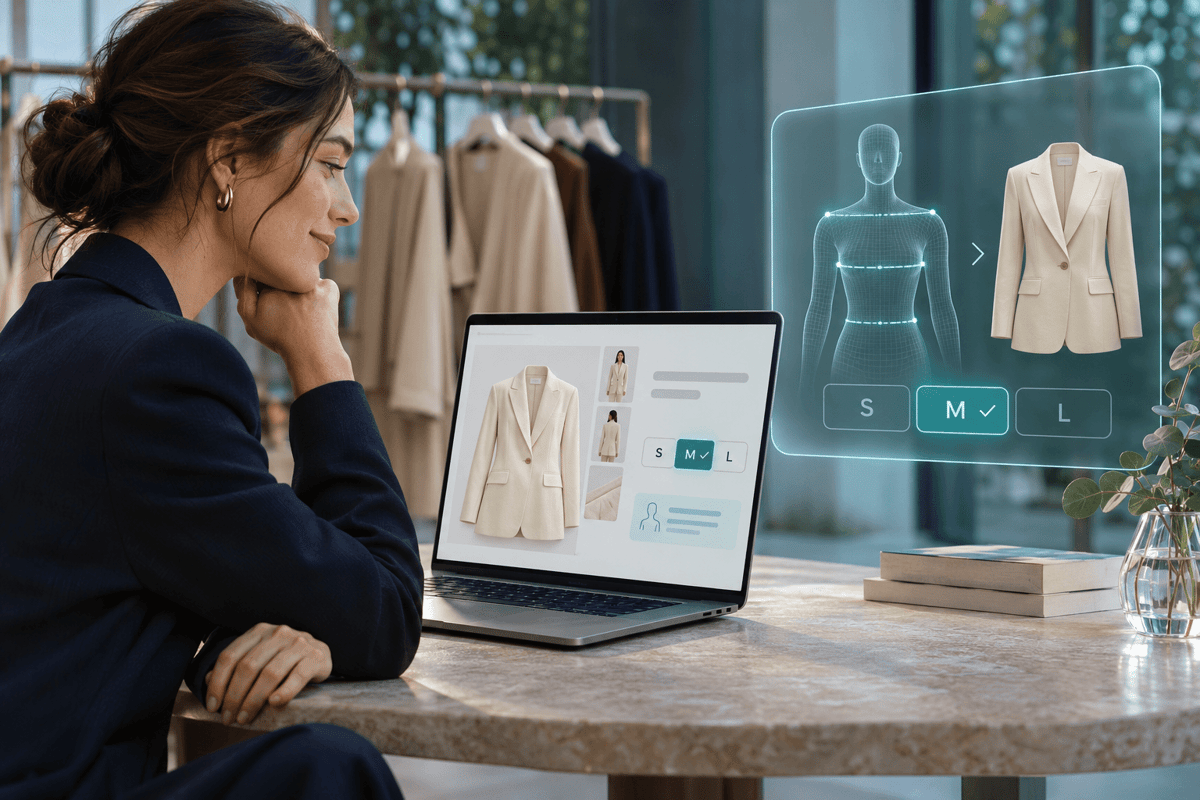 Image Source: AI
If you run ecommerce for a fashion apparel or footwear brand, the size recommendation software you choose will decide how many size-uncertain shoppers buy and how many of those orders come back as returns. Approximately 52% of shoppers hesitate to complete a purchase when they are unsure about fit, and close to 6 in 10 say they won't buy online from a brand they aren't familiar with.
Size recommendation software is an interactive tool on the product page that asks the shopper a few questions and returns a personalized size for that specific product, so the shopper doesn't have to guess themselves.
Which type of solution fits your store depends on three aspects: your catalog type, the product data you hold, and how quickly your SKUs turn over.
What Size Recommendation Software Does on the Product Page
Size recommendation software, in the form of an AI Size Advisor, takes a handful of shopper inputs and returns the size most likely to fit for the product on screen. Shoppers get the response in under a minute, without a tape measure. The tool sits next to the size selector, so the answer arrives at the moment the shopper is deciding.
It exists because the physical store fitting room has no online equivalent. In a boutique, the shopper tries two sizes and keeps one. Online, that same shopper either guesses, orders both sizes, or leaves. Everything this guide covers is about helping the shopper close that gap with a size recommendation the shopper trusts.
The Two Costs Size Recommendation Software Is Bought to Fix
The Cost You Already Track: Size and Fit Returns
Size and fit drive 40-60% of fashion returns, and dresses, pants and footwear sit at the higher end of the 40-70% range. Each return costs an estimated $20-$30 per item once shipping, labor and loss of value are counted. This is the number most teams bring to a first vendor call, because it already sits in a finance report.
The Bigger Cost: Shoppers Who Never Buy
The higher cost is harder to see. A shopper who abandons a product page over size will not appear in the returns report. Returns are the downstream result of a sizing decision that has already gone wrong. Conversion is the upstream lever, because it decides whether the size-uncertain shopper buys at all. According to a Business of Fashion survey, Fashion shoppers in the UK, Germany, France, Italy and Spain named finding the right size or fit as their top online pain point (44%), ahead of unclear product descriptions (33%) and slow/expensive delivery (33%).
Three Types of Ecommerce Fit Technology
Size recommendation software is one of three tools that solve different problems. Buyers often end up comparing a size chart app with a Size Advisor, so it helps how the approaches differ from each other.
The Size Guide
The Size Guide comes in two variants:
A body (anthropometric) chart lists which size maps to which bust, waist and hip range, usually one chart per gender. It is simple to maintain, but the shopper has to know their own measurements.
A garment (product measurement) chart lists the physical dimensions of each size of each product. It is more granular and a better input for a recommendation engine, but it means a separate chart per product, and shoppers find it hard to read as they either compare those garment measurements against a similar category & fit product, or have to guess fit tolerance (difference between their body measurements and garment measurements).
The Size Guide stays on the product page after a Size Advisor goes live. A share of shoppers will always use the Size Guide, including cross-border shoppers checking international sizes, and with Measmerize, the Size Guide is part of the same offer at no additional cost.
The AI Size Advisor
This is the category this guide covers: shopper provides inputs, gets a personalized size as a response. The category has existed since the 2010s, so maturity differs widely between approaches taken to this category. We discuss the three widely used approaches in detail below.
Virtual Try On
Virtual Try On is brand new and moving fast. It answers how a garment looks on the shopper, which is a different question from which size to order. Current tools use four implementations:
- an AR overlay on a static photo
- full image regeneration of the shopper with the garment applied,
- A live video overlay on the camera feed, and
- AI-generated video of the shopper moving in the garment.
The credibility problem is real. Many tools show any garment fitting perfectly on any body, regardless of the product's proportions.
Over time, that erodes trust in the try-on and in the size the shopper picked. Measmerize's Virtual Try On (or Virtual Dressing Room, as we call it internally) starts from the shopper's size: it shows the garment on the shopper's avatar in the recommended size and in one size either side, so they can see how the fit changes.
Three Types of Size Advisor and Where Each One Works
Within the Size Advisor category, every vendor starts from one of three approaches. Each has a genuine strength, and each has a limitation that matters for some catalogs more than others.
Pure Machine Learning (Collaborative Filtering)
Pure Machine Learning has the simplest experience for the shopper. It asks basic questions any shopper can answer from anywhere, so adoption is high. Multibrand retailers and marketplaces gain the most, because the approach needs no garment measurement data to launch.
The trade-off is the cold-start problem. The recommendation comes from what similar shoppers bought and kept, which does not work well with new product launches with zero purchase history. It works best for a large and stable catalog (500+ active SKUs) with 2+ years of purchase and return history per SKU.
It also can't tell a shopper that a jacket is tight on the shoulders but fine on the chest, because it never compares body and garment measurements. And the fit message arrives late, since the approach needs more sales and returns per SKU before it says anything useful.
Providers include True Fit, Fit Analytics (product: Fit Finder) and Secret Sauce Partners (product: Fit Predictor).
Body Scanning (Computer Vision)
Body Scanning starts from real body measurements, so its accuracy potential is high when the scan is good. The friction is also high. The shopper needs camera access, good lighting and the right position, and many hesitate over privacy. In practice, the scan gets used by shoppers who have already decided to buy and want to confirm a size.
That makes Body Scanning mainly a returns tool, with lesser effects on conversion.
Digital Twin (Measurement-Based Estimation)
Digital Twin is accurate from a product's first day online, with no cold-start period. There is no camera, so more shoppers complete it, and it takes under a minute to complete.
For apparel, the shopper gives gender, age, weight, height, bra size for womenswear, and a description of body shape such as shoulder breadth. For footwear, the inputs are gender, country of origin, the first shoe size they would try in a boutique, and foot width.
The answers become an estimated 3D model of the shopper's body. The engine then finds the size whose product measurements sit closest to the shopper's own, and sales and returns data refine the recommendation over time through a Machine Learning feedback loop.
The limitation is garment data. The retailer has to supply garment information, either anthropometric measurements from pattern-making or garment measurements from the tech pack. One client's size chart showed a shopper with a 92cm chest and a 73cm waist as a size 40 on two products using the size chart, when she was a 38 on one and a 42 on the other. A single chart can hide a full size of error in both directions, which is why the data step matters.
Measmerize uses the Digital Twin approach. See How It Works.
Which Approach Fits Your Catalog
The right Size Advisor depends on the catalog in front of you. Use this table as an initial filter.
| Retailer situation | Approach that tends to fit | Why |
|---|---|---|
| Multibrand retailer with limited product data | Digital Twin | The vendor can fill the gaps during onboarding, taking some attributes from product descriptions |
| Large and stable catalog (500+ active SKUs) with 2+ years of purchase and return history per SKU | Pure Machine Learning or Digital Twin | Enough history for collaborative filtering to work |
| Seasonal collections, short SKU life or frequent new launches | Digital Twin | Accurate from day one, no cold-start |
| Goal is to confirm fit for shoppers who have already decided to buy | Body Scanning (Computer Vision) | Mainly reduces returns among committed buyers |
| Shopify store that wants to go live without developer time | Digital Twin via the Measmerize Shopify app | No-code install from the Shopify App Store |
If you're weighing Measmerize against a Pure Machine Learning vendor, see our comparisons with True Fit and Fit Analytics.
Four Questions to Ask Any Size Recommendation Vendor
These four questions come from Measmerize's own vendor diligence framework. Ask them on a live call, and ask to see each answer working on your own products.
How Does Your System Work When a Product Has Zero Purchase History?
This exposes the cold-start problem. Ask what a shopper sees on launch day for a brand-new SKU. If the answer is a generic size or a fallback to a similar product, expect weak recommendations for every new collection, until sales build up.
What Product Data Do You Use, and How?
Collecting product data is labor-intensive, so you need to know what you can leave out and what that costs in accuracy. Product data sits in four places inside most retailers: product measurements with production or the tech pack, anthropometric measurements with the pattern-making team, the size chart with ecommerce, and the assortment decision with merchandising.
A vendor that claims a Digital Twin approach but says it can work from one generic size chart per gender doesn't add up, because every garment fits differently across suppliers and fabrics.
What Exactly Is Your KPI Based On?
Ask whether a returns figure compares shoppers who follow the recommendation with shoppers who don't, whether it is isolated from adoption rate, or whether it is something broader.
How Does Your Tool Behave When a Shopper Declines Cookie Consent?
This is your compliance obligation as the retailer. Run the test live: decline all cookies, open a product page, get a recommendation, then open a second product page and check if the tool still loads and recommends.
If you sell into mainland China, ask where the servers sit, because PIPL requires data localization on servers physically in China.
How to Read a Vendor's Results Before You Sign
Adoption Rate Reflects Size-Uncertain Shoppers, Not All Shoppers
A low open rate is expected. Shoppers who already know their size don't need the tool. Measmerize sees an Open Rate of 3-6% of product page users, skewed lower by luxury clients who prefer a minimalist call to action. Completion Rate runs at 75-90%, Recommendation Rate at 2.5-5.5% of product page traffic, and 15-25% of a client's ecommerce sales running through a recommendation.
Return Reduction Is Scoped to Size and Fit Returns
Keep every returns figure tied to its scope. Evaluate size-and-fit specific return rate for shoppers who follow the recommendation and compare with shoppers who don't. What is the return rate comparing to? An A/B test? Users who use the size chart? The devil is in the details.
What Go-Live Actually Requires
Go-live depends on which product you buy. The three steps below describe the Measmerize Shopify app (Self Service). Data gathering takes about 2 days, and only if product data isn't readily available. Installing, uploading and customizing takes about 1 day, and some clients have gone live in under 10 minutes.
Install the App
Install the Measmerize app from the Shopify App Store with no code: choose the theme, activate it, drag and drop the placement and customize in the Shopify Editor. This takes 5-10 minutes depending on how much you customize. See Shopify pricing and plans.
Create the Size Chart
Pick your most reliable product data. Measmerize accepts anthropometric measurements from pattern-making and garment measurements from the tech pack, uploaded one by one or in bulk. Automated checks confirm the data is directionally correct, and a calibration step lets you confirm the recommendation is the one you expect. The Shopify Academy guide on calibrating size recommendations before launch walks through it. Allow 10 minutes to a couple of hours.
Mapping Size Chart to Products
Assign each product to its chart if the bulk upload didn't already complete that step. This is the step that gives the recommendation and the Smart Size Chart their product-level granularity.
How Enterprise Go-Live Differs
Enterprise takes about three weeks.
In week one, the retailer shares product information in any format, including measurements, tech packs and attributes such as intended fit and fabric, with SFTP for ongoing feeds.
In weeks two and three, Measmerize customizes the widget and checks the data: it scores every SKU and arranges physical try-ons by people with known body measurements for products that score low. Go-live is two lines of JavaScript on the product page, on any platform, headless included.
The longer timeline is the reason Enterprise recommendations are accurate from day one: the data problems get fixed before shoppers see a size.
The Measmerize Advantage: Solving the Cold-Start Sizing Problem
Most size recommendation software learns from purchase and return history, so it starts every new product at zero. Measmerize starts from the garment. The Digital Twin compares the shopper's estimated body with the product's own measurements, which is why a coat gets an accurate recommendation on its first day online. Sales and returns data then refine it, instead of having to teach it from scratch.
The trade-off is data. Measmerize needs garment information that a Pure Machine Learning vendor doesn't, and for a multibrand retailer with no product data, that is real work. Measmerize does that work with you on Enterprise, and checks your data automatically on Shopify.
Measmerize offers a Smart Size Guide, a Size Advisor using the Digital Twin approach with an optional Body Scanner, and Virtual Try On paired with the Size Advisor, available as an enterprise solution and as a Shopify plug-in.
If you run a Shopify store, start on Shopify.
If you run an enterprise storefront, book a call and test it on your own catalog.
Frequently Asked Questions
What is size recommendation software?
Size recommendation software is a product page tool that turns a few shopper inputs, such as height, weight and age, into a personalized size for a specific product. It is one of three types of ecommerce fit technology, alongside the Size Guide and Virtual Try On. The job of a size recommendation software is to give size-uncertain shoppers enough confidence to buy.
What is the best AI size recommendation tool for a fashion ecommerce store?
The best tool depends on your catalog. Pure Machine Learning tools suit marketplaces with stable catalogs and years of purchase history. Digital Twin tools such as Measmerize suit retailers with seasonal collections or frequent launches, because they are accurate from a product's first day. Body Scanning suits committed shoppers confirming a size.
What are the alternatives to True Fit and Fit Analytics?
True Fit and Fit Analytics use Pure Machine Learning, which suit marketplaces with stable catalogs and years of purchase history. Digital Twin tools such as Measmerize compare an estimated 3D body model with garment measurements, and is better suited for retailers with seasonal collections or frequent launches, since it is accurate from day one without prior shopping history required.
How accurate are size recommendation tools on new products?
Accuracy on new products depends on the approach. Pure Machine Learning has no purchase history for a new SKU, so early recommendations are weak until sales and returns build up. Digital Twin tools like Measmerize are accurate from the first day a product is online, because it starts from the garment's measurements.
Do I still need a size chart if I add a Size Advisor?
Yes. A share of shoppers will always use the size chart, including cross-border shoppers checking international sizes. With Measmerize, the Smart Size Chart is part of the same offer at no additional cost, and it is built from the same product data as the Size Advisor, so the chart and the recommendation are in sync.
Which size recommendation tools work with Shopify?
Several Size Advisors offer Shopify apps. Measmerize installs from the Shopify App Store without code in three steps: install the app, create the size chart, and map size charts to products.
How long does it take to launch size recommendation software?
With the Measmerize Shopify app, plan about 1 day to install, upload and customize, plus about 2 days of data gathering if your product data isn't ready. Some clients have gone live in under 10 minutes. Enterprise takes about three weeks, because Measmerize checks every SKU before launch.