Ecommerce Fit Tech: How Each Type of Size Recommendation Solution Works, and How to Choose One
If you run ecommerce for a fashion brand, you have learnt the hard way that size uncertainty at the shopping stage leads to returns in the long-term. Size and fit drive 40% to 70% of fashion returns depending on category, with dresses and footwear at the higher end. Each returned item costs an estimated $20 to $30 to process before considering the added risk of the item remaining unsold during markdowns.
But there's a second cost that is harder to measure. Close to 6 in 10 shoppers won't buy online from a brand whose sizing they’re not familiar with. That shopper leaves the product detail page without converting, and the missed sale doesn't show up anywhere in your P&L. For brands with a large share of first-time shoppers, this is usually the bigger of the two costs.
The category of technology that handles both costs is called ecommerce fit tech.
It covers three distinct types of tools, each built on a different data model, suited to different retail situations, and having different impacts on the two costs above. Pick the wrong type for your catalog situation and you can end up wasting budget.
The Three Types of Ecommerce Fit Technology
Ecommerce fit technology is any tool that helps an online shopper find the right size without trying it on. Before you evaluate any vendor, you need to know which one you are actually buying.
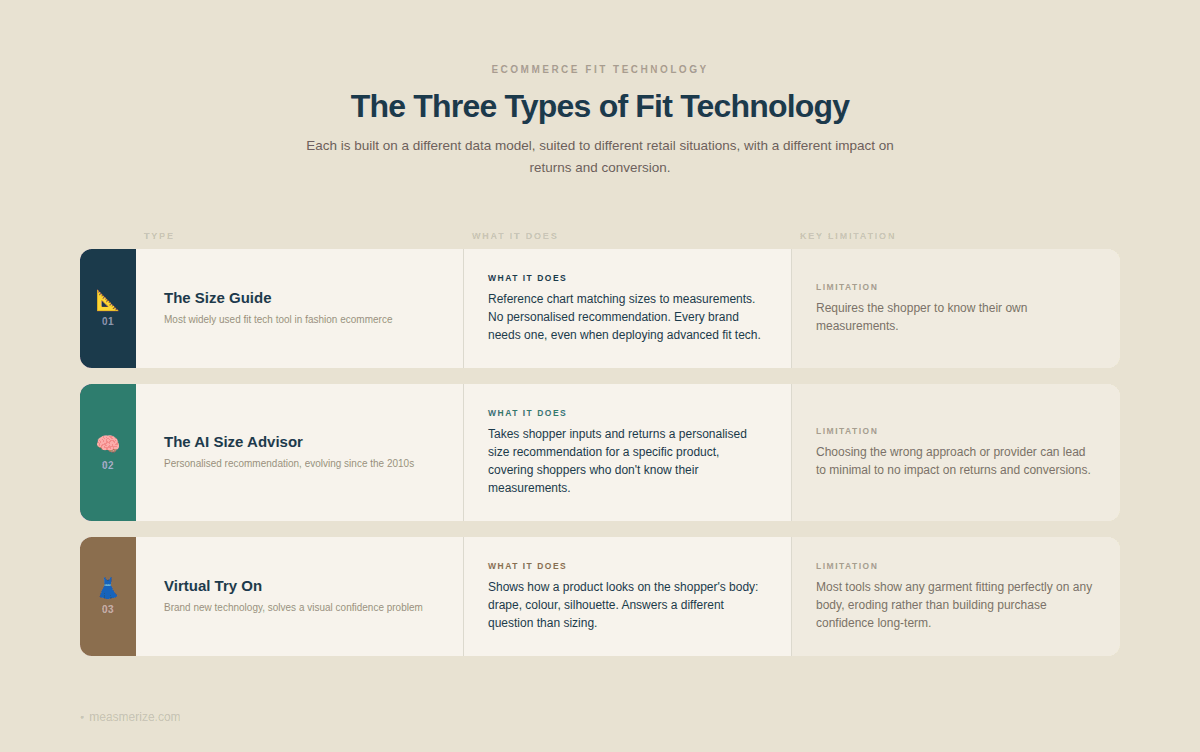
The Size Guide
The Size Guide is the most widely used fit tech tool in fashion ecommerce. It provides reference information (size-to-measurement equivalences) without a personalized recommendation. The shopper has to know their own measurements, or be willing to measure themselves or an already owned garment.
Two types of size guides exist. The more common one uses body or anthropometric measurements: typically a single chart per gender showing which size maps to which bust, waist, and hip range. The second uses garment or product measurements, SKU-specific charts showing the actual physical dimensions of each size. More granular and more accurate, but it means maintaining a separate chart for every product.
Even brands deploying the most advanced fit tech still need a well-maintained size guide. A large share of shoppers who land on any product page will simply use the chart, including cross-border shoppers consulting international clothing size charts for the first time or working out a US shoe size conversion from an unfamiliar market.
The AI Size Advisor
A Size advisor takes inputs from a shopper and returns a personalized size recommendation for a specific product. It covers the shopper who doesn't know their measurements, doesn't know the brand's sizing, or has a body shape that doesn't map cleanly to a standard chart.
Size advisors have been evolving since the 2010s. The market has settled into three distinct approaches. For a retailer evaluating vendors, the relevant question is which type fits the catalog situation and compliance requirements. More on this below.
Virtual Try On
Virtual Try On answers a different question entirely. Instead of telling a shopper which size to order, it shows them how a product would look on their body: the drape, the color against their skin tone, the fit silhouette. It solves a style and visual confidence problem.
Four implementations exist right now, which are occasionally mixed & matched:
-
AR overlay (the product layered on a static photo of the shopper)
-
Full image regeneration (the shopper's face and body recreated digitally with the garment applied),
-
Live video overlay on a camera feed
-
AI-generated video showing the shopper moving in the garment
Virtual Try On is brand new technology, advancing rapidly. The main limitation in many current implementations is a credibility problem: most tools show any garment fitting perfectly on any body, including proportions that clearly don't match the product's intended range. In the long term, trust will erode rather than build purchase confidence.
The Three Types of Size Advisor
Within the Size advisor category, the market can be broken down into three main approaches: Pure Machine Learning, Body Scanning, and Digital Twin.
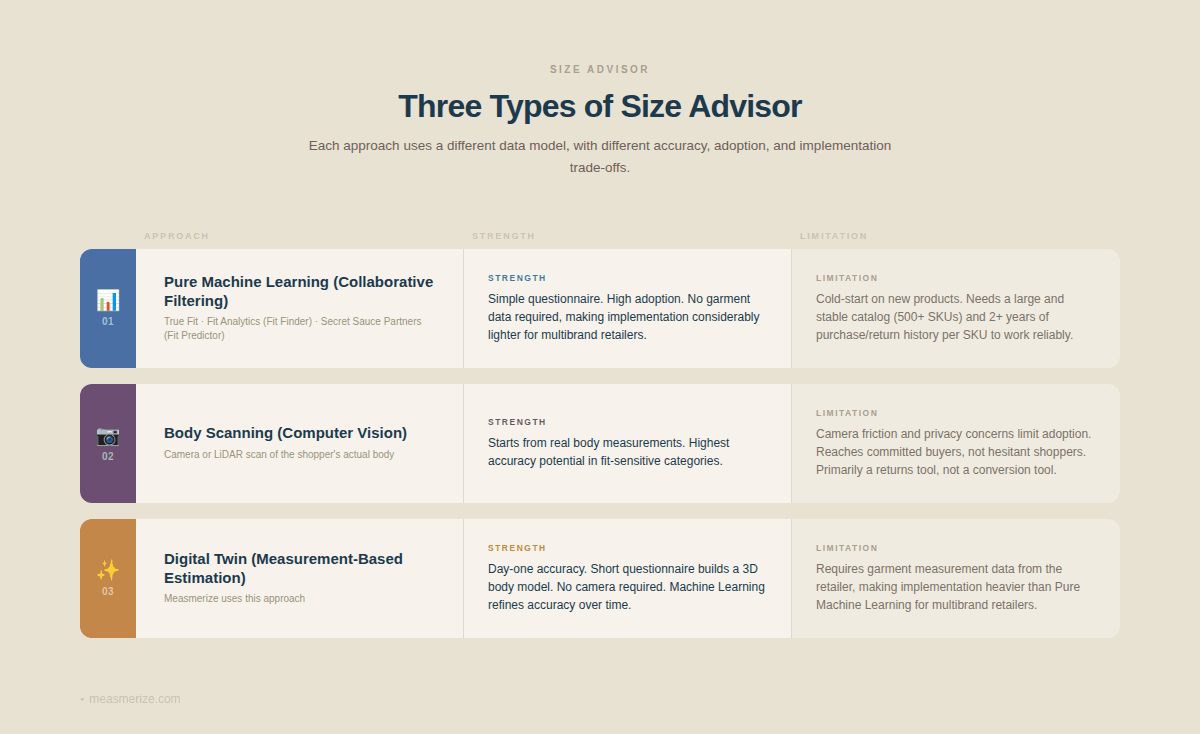
Each uses a different data mode and produces a different type of recommendation depending on catalog size, product data quality, and shopper mix.
Pure Machine Learning (Collaborative Filtering)
The named Pure Machine Learning providers are True Fit, Fit Analytics (Fit Finder), and Secret Sauce Partners (Fit Predictor). They work by clustering shoppers based on indirect signals: demographic questions, purchase behavior, and return history. The system finds groups of shoppers who bought and kept the same items, then recommends the size that similar shoppers purchased and didn't return.
The questionnaire is simple: basic demographic questions that any consumer can answer from anywhere. That simplicity produces high adoption rates compared to approaches that require body measurements or camera access.
For a multibrand retailer or marketplace, there's an additional advantage: Pure Machine Learning doesn't require the retailer to supply garment measurement data, which makes implementation considerably lighter.
The cold-start problem is the main limitation: Every new product launches with zero purchase history and an inaccurate recommendation that only improves as shoppers buy and return it. For a brand with a new catalog or a new international market, this is a real constraint. A SKU can reach the end of its commercial life before the recommendation has accumulated enough signal to be useful.
There's also a depth limitation. Because the recommendation doesn't pass through a comparison of actual body measurements and garment measurements, these providers can't tell the shopper how a garment fits their specific body. They can't flag that it will be tight across the shoulders while fitting fine in the chest, making the experience not very personalized. The recommendation is a prediction based on similar-shopper outcomes.
Body Scanning (Computer Vision)
Body Scanning measures the shopper's actual body using a camera or LiDAR scan. Those dimensions are then compared against the garment's measurements to find the size whose physical specifications are closest to the shopper's body.
When the scan captures good data, the recommendation starts from real body measurements rather than inferred estimates. That's the genuine advantage, especially in fit-sensitive categories. Adoption is the problem. The scan step requires a camera (typically a mobile phone), good lighting, and specific body positioning, and it raises privacy concerns for a large share of online shoppers.
That combination of friction and privacy hesitation means body scanning tools tend to be used by shoppers who have already decided to buy and want to confirm fit before ordering, not by the size-uncertain shopper who's still deciding.
Digital Twin (Measurement-Based Estimation)
Digital Twin Size Advisors estimate a shopper's body measurements from a short and intuitive questionnaire, builds a 3D model of the shopper's body, and compare those estimated body dimensions against the measurements of the body that fits perfectly in that size of that garment. Measmerize uses this approach, which is documented in the Measmerize white paper.
In Measmerize’s case, for apparel, the questionnaire inputs are: gender, age, weight, height, bra size (only for women) and a qualitative description of your body (e.g. adapting the shoulder breadth of a digital avatar).
For footwear: gender, country of origin, first shoe size you would try in a boutique, and foot width.
Day-one accuracy is the defining advantage. Because the recommendation starts from garment measurements rather than accumulated purchase history, it accurately captures the specifics and differences of how each different product fits. . A Machine Learning feedback loop then fine-tunes the recommendation over time using sales and returns data, so accuracy improves as the data set grows, but doesn't depend on it to start.
Data dependency is the real limitation. To compare a shopper's estimated body against a specific garment, the system needs some information about the garment's measurements. The retailer must supply either a size guide with anthropometric measurements, or product measurements (tech pack data).
For a multibrand retailer or marketplace with no product data infrastructure, implementation is considerably more demanding than a Pure Machine Learning approach.
What Each Approach Gets Right, and Where Each Breaks Down
The right approach depends on the catalog situation, the shopper mix, and compliance requirements. Three scenarios cover the terrain most retailers are actually operating in.
If You Have a Large and Stable Catalog and Years of Purchase Data
A retailer with 500 or more active SKUs and at least two years of purchase and return history per SKU has the data Pure Machine Learning needs to work reliably. At that scale, the cold-start problem affects only new catalog additions, not the core inventory, and recommendation quality for established products is high.
For this situation, Pure Machine Learning is a defensible choice. The evaluation question is how well a specific vendor handles the cold-start period for new products.
Ask directly: "For a product we launch today with no purchase history, what does your recommendation look like on day one? How long do we require to tailor the recommendation to that specific SKU?"
If the vendor acknowledges the limitation and has a concrete approach for managing it, a fallback to category-level recommendations, that's an honest answer.
If You are Launching a New Brand or in a New Market
A brand with a new catalog or launching in a new international market cannot wait for purchase history. Where SKUs cycle through in weeks rather than months, a Pure Machine Learning approach restarts at zero for every new product. A SKU may not accumulate useful data before it's been replaced.
For this situation, a measurement-based approach is the better fit. Digital Twin produces the same recommendation quality on day one as it will after a year of data, because the recommendation derives from the garment's actual measurements rather than from prior buyers.
The main trade-off is data dependency. A measurement-based approach requires the retailer to supply garment measurement data before go-live, which requires product data infrastructure. For brands that already maintain tech packs or granular size guides, that's manageable.
If You Take Privacy and Cookie Compliance Seriously
Any Size Advisor that stores shopper data (body measurements, size preferences, purchase signals) operates simultaneously inside GDPR for EU shoppers, PIPL for Chinese market shoppers, and CCPA for California shoppers, if the brand sells into those markets. Most brands with international traffic hit all three. A tool that injects tracking cookies before a shopper has consented, or that doesn't adjust its behavior based on consent choice, is non-compliant.
The easiest technical workaround for vendors who haven't built proper consent-management integration is to hide the Size Advisor from shoppers who decline cookies. In EU markets, where cookie consent decline rates are high, that can remove the tool from a substantial share of traffic, eliminating conversion and return-rate impact exactly where the cost of returns is highest.
The right approach reads the shopper's consent preference automatically, via integration with the brand's existing consent management platform such as OneTrust, and adjusts what it injects accordingly without hiding the size advisor.
Ask any vendor for a live demonstration: decline all cookies in your browser, then verify the tool still loads and functions. Then browse to a Product Details Page and receive a Size Recommendation, and then browse to a second PdP. If the tool disappears behind a consent wall, or you receive a recommendation on the second product without re-inputting your data, the vendor hasn't solved the compliance problem.
For brands in the Chinese market specifically, PIPL compliance requires data localization: servers physically located in China, not just data routed through China. It's a vendor-selection question, not a configuration option.
What Fit Tech Looks Like When It's Working
Most conversations about fit tech performance start and end with returns. That's the cost brands already track, and vendors know it's the easiest number to lead with. Understanding which technology type addresses the appropriate cost for the right shopper leads to a better vendor evaluation.
The Return Cost: What Brands Are Already Tracking
Size and fit drive 40% to 70% of fashion returns depending on category, with dresses, pants, and footwear at the higher end of that range. Each returned item costs an estimated $20 to $30 to process through reverse logistics and re-inspection, before markdown risk on items that can't be resold at full price.
Here's the documented impact on that cost. Measmerize's own benchmark, is a 40% lower size-and-fit return rate among shoppers who followed a recommendation, compared to shoppers who didn't.
That figure is a difference-in-return-rate metric between two shopper groups. It's not an overall return rate reduction for the brand. Stating it as ‘40% fewer returns’ without that scope is a factual inaccuracy and deliberately misleading.
Ask any vendor quoting a returns figure: ‘Forty percent lower than what? Among which shoppers? What was the control?’
All three size advisor types address size-and-fit returns to some degree, for shoppers who were uncertain about their size and followed a recommendation. Body scanning, given its adoption friction, tends to reach shoppers who have already committed to the purchase. That makes it primarily a returns tool.
Pure Machine Learning and Digital Twin reach a broader range of shoppers earlier in the decision, before they have committed.
The Conversion Cost — The Harder Number to See
Conversion, unlike returns reduction, is the upstream lever: a size recommendation that convinces a hesitant shopper to complete the purchase. It captures the sale and, if the recommendation is accurate, reduces the likelihood of a size-and-fit return from that same shopper.
The brands that bear this cost most heavily are those with a high proportion of first-time buyers or retailers entering a new international market. These are exactly the situations where purchase history is sparse and where a Pure Machine Learning approach has the least data to work from.
The most recent A/B tests run by Measmerize on global retailers showed conversion rate uplifts of 7.5% and 26.3% at the Product Details Page level in segments where the size advisor was available alongside the traditional size guide, vs. when only the traditional size guide was available. The mechanism behind the 26.3% result matters.
In the control segment (only size guide available, no Fit Finder solution), roughly 2% of product detail page (PdP) traffic used the size guide. In the test segment (size guide + size recommendation solution), size guide usage dropped slightly to 1.4% due to some cannibalization, but an additional 2.5% of product detail page (PdP) traffic used the size advisor, bringing total size-guidance usage from 2% to 3.9%. That increase in the share of shoppers who received size guidance before the purchase decision drove the uplift.
Digital Twin and well-implemented Pure Machine Learning approaches address the conversion cost for size-uncertain shoppers who complete the questionnaire. Body scanning, given its adoption friction, reaches mainly committed buyers and adds less to conversion.
Questions to Ask Any Fit Tech Vendor Before You Commit
Most fit tech vendor evaluations go wrong in the same three places: they take day-one accuracy claims at face value, accept KPI figures without checking what's actually being compared, and skip the compliance question entirely. These questions get to the distinctions that matter.
How Does Your System Work When a Product Has Zero Purchase History?
Ask this specifically:
‘For a product we launch today, with no purchase history, what does your recommendation look like on day one? And on day 90? What data is used to make the recommendation today vs. on day 90?’
A Pure Machine Learning vendor should acknowledge honestly that the day-one recommendation is less accurate than the day-ninety recommendation, and that it improves as purchase and return data accumulates. If your catalog is large and stable and you have two or more years of data per SKU, the cold-start period for new products may be an acceptable trade-off. What should give you pause is any claim that day-one accuracy is equivalent to day-ninety accuracy without garment measurement data. That claim doesn't hold.
A Digital Twin vendor starts from garment measurements rather than purchase history, so day-one accuracy is the baseline. The recommendation doesn't need to accumulate data to start working. The trade-off, which the vendor should also acknowledge, is that this approach requires you to provide garment measurement data before go-live.
What product data do you use, and how?
Highlight to your vendor that getting product information is labor intensive for the team, and try and understand what information you can do without, what is the impact on accuracy, and how do they mitigate the drop in accuracy.
All fit tech vendors will minimize this issue, the question is how much.
If a provider has described their approach as a Digital Twin approach, which uses product information comparing it to body measurements, but then tells you they can make accurate recommendations on a generic gender-level size chart, something doesn’t add up.
Every garment fits slightly differently. Different suppliers, different fit, different fabric all leads to the inconsistencies in sizing that any retailer or brand is familiar with.
With a brand or gender-level size chart those differences can’t be identified. If a supplier tells you otherwise, they are either using a Pure Machine Learning approach, or stretching the truth.
Challenge them in-depth on how they identify those differences between products, at scale. That will make all the difference between your return rate percentage dropping, or not.
What Exactly Is Your KPI Based On?
Fit tech vendor pitches routinely blend two different comparisons into a single headline number:
Get specific on both the conversion rate claim and the return rate claim before accepting either.
For conversion rate: a page-level A/B test, one segment of product page traffic with the tool available, one segment without, is the rigorous measurement. Size-uncertain shoppers who open a sizing tool are already more likely to convert than shoppers who ignore it.
For return rate: ask whether the figure is total returns or size-and-fit returns specifically. Returns from damaged goods, wrong items shipped, or buyer's remorse are not addressable by a size advisor. Is the number an overall return rate drop, or a comparison between return rates of users using a tool and users who don’t? A vendor citing a total return rate reduction figure without scoping it to fit-and-size-related returns is either measuring something else, or presenting the number in a way that overstates fit tech's contribution.
In all of the above cases, ask for the statistical significance level and confidence interval. A result that isn't statistically significant at 95% confidence shouldn't drive a contract decision.
How Does Your Tool Behave When a Shopper Declines Cookie Consent?
This is the question most evaluations skip: It matters most for brands with EU, UK, or Chinese market traffic, which now includes most brands operating at scale.
Any tool that stores body measurement data or size preferences without consent falls under GDPR, PIPL, or CCPA depending on where the shopper is located. The correct implementation reads the shopper's consent choice automatically, via integration with the brand's existing consent management platform, and adjusts what the tool injects accordingly, without hiding it. A shopper who has declined cookies should still see the size advisor, without injecting tracking cookies the shopper hasn't consented to.
FAQ - Ecommerce Fit Tech Questions
What is ecommerce fit technology?
Ecommerce fit technology covers any tool that helps an online shopper find the right size for a specific product without trying it on. Three main categories: the Size Guide (a static reference tool providing size-to-measurement equivalences), the Size Advisor (an interactive tool that takes shopper inputs and returns a personalized recommendation), and Virtual Try On (technology that shows how a garment would look on a specific shopper's body). Within the Size Advisor category, three distinct approaches exist: Pure Machine Learning, Body Scanning, and Digital Twin.
What is a Size Advisor?
A Size Advisor takes inputs from a shopper, typically a questionnaire or body scan, and returns a personalized size recommendation for a specific product, without the shopper having to measure themselves or interpret a size chart. It's distinct from a Size Guide, which provides reference information but no personalized recommendation, and from Virtual Try On, which shows how a product looks on the body rather than which size to order. Size Advisors have been part of fashion ecommerce since the 2010s and fall into three technical categories with meaningfully different mechanisms.
Does fit technology actually reduce returns?
Yes. Specifically, size-and-fit-related returns among shoppers who were uncertain about their size and followed a recommendation. Fit technology doesn't reduce returns from damaged goods, incorrect shipments, or buyer's remorse, and it doesn't affect returns from shoppers who already knew their size and would have kept the item regardless. The measurable impact is on the size-challenged shopper. Measmerize's white paper documents a 40% lower size-and-fit return rate among shoppers who followed a recommendation versus those who didn't, stated as a difference between those two groups, not as an overall brand return rate reduction. The most recent A/B tests on global retailers showed 16% and 20% lower size-and-fit returns at the page level in segments where the Size Advisor was available.
What is the cold-start problem in sizing technology?
The cold-start problem is the inability of purchase-history-based approaches to give accurate recommendations for products with no accumulated purchase and return data. Every new product starts with zero history, which means every new product starts with an inaccurate recommendation that only improves as shoppers buy and return it over time. For brands with a large, stable catalog and two or more years of data per SKU, the cold-start period for new additions is manageable. For brands with fast-turnover catalogs, new international markets, or new season launches, it's the primary accuracy constraint. Digital Twin approaches don't have a cold-start problem because they derive recommendations from garment measurements rather than purchase history.